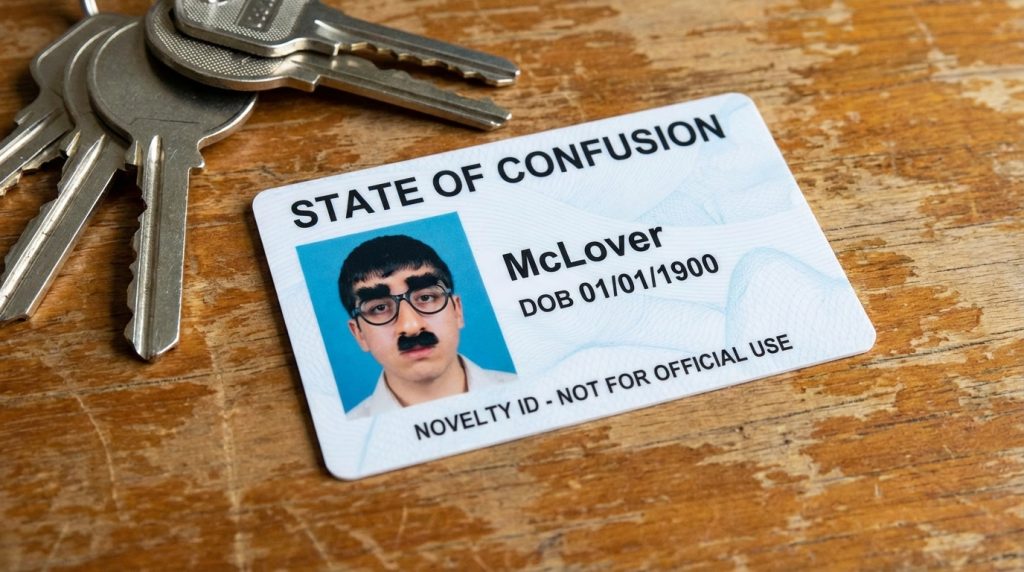
In the realms of psychological research, immersive theater, and high-stakes corporate training, there is a concept known as “narrative transport.” This occurs when an individual becomes so lost in a story or simulation that their brain begins to process the experience as reality. Achieving this state requires more than just a good script; it requires a physical world that doesn’t break the illusion. Among the most potent tools for anchoring this immersion is the novelty id.
While often viewed simply as a piece of plastic, a professionally crafted replica serves as a psychological “totem.” It provides a tangible link to a fictional or simulated identity, allowing the user to bypass the skepticism of the logical mind. As we look at the standards of 2026, the demand for “niche edit” quality in these items has never been higher, driven by a deeper understanding of how detail affects human perception.
The “Uncanny Valley” of Prop Design
In robotics and CGI, the “uncanny valley” describes the revulsion felt when a non-human entity looks almost—but not quite—human. A similar phenomenon exists in prop design. When a participant in a high-end escape room or a security training exercise handles a novelty id that feels like cheap cardstock or features “flat” graphics, the immersion is instantly shattered. The brain flags the discrepancy, and the psychological anchor is lost.
To prevent this, modern creators focus on “sensory consistency.” This means the prop must satisfy multiple senses simultaneously. It must have the correct visual depth, the specific tactile “snap” of professional PVC, and the reflective properties of genuine security features. For those seeking to understand the technical benchmarks that prevent this immersion break, the guide on Novelty IDs vs Fake IDs provides a crucial framework for distinguishing high-fidelity replicas from substandard imitations.
Tactile Materiality: Why the Brain Craves Weight
Psychologists have long noted that the weight and texture of an object influence our perception of its importance. This is known as “embodied cognition.” In a corporate “Red Team” exercise or a cinematic production, if a character is supposed to be a high-ranking official, their identification must feel “heavy” with authority.
High-quality replicas utilize materials like PVC and Teslin to achieve this.
- PVC (Polyvinyl Chloride): Provides the rigidity and durability required for items that are handled, swiped, or presented frequently.
- Teslin: Offers a unique, microporous texture that allows for high-resolution ink absorption, ensuring that “ghost images” and micro-text are crisp and believable under close inspection.
When a participant feels the familiar weight and texture of these materials, their brain accepts the premise of the simulation more readily, leading to more authentic reactions and better training outcomes.
Strategic Applications: From ARGs to Crisis Management
The need for high-fidelity novelty id props extends into several sophisticated fields:
1. Alternate Reality Games (ARGs)
In ARGs, the game world bleeds into the real world. Players may find “lost” wallets or receive credentials in the mail. The realism of these items is what makes the game world feel “dangerous” or “important,” driving higher levels of player engagement and social sharing.
2. Crisis Management and Disaster Simulations
First responders and emergency managers often use “mock victims” and “simulated civilians” during drills. Providing these actors with realistic identification allows responders to practice the high-pressure task of verifying information while managing a crisis, ensuring that the training translates to real-world competence.
3. Historical Reenactment and Museums
Preserving the visual language of the past requires precision. High-quality replicas allow museums and reenactors to display the evolution of document design without risking the loss of fragile, historical originals.
The Ethical Boundary: Authenticity vs. Integrity
As technology makes high-fidelity replicas more accessible, the industry has reinforced its commitment to ethical boundaries. A professional novelty id is a tool for creativity, education, and immersion. It is designed to enhance a story or a training exercise, not to facilitate deception in official settings.
Reputable providers in 2026 prioritize design integrity, ensuring that their products are clearly categorized as novelty items. By maintaining this distinction, the industry protects the creative freedom of prop masters and educators while respecting the legal structures of identity verification.
Conclusion
The power of a novelty id lies in its ability to silence the inner critic. By focusing on the microscopic details of typography, material science, and security simulation, designers create more than just a prop; they create a portal to another reality. Whether it is for a viral video, a theater production, or a life-saving training drill, the quality of the replica is what ensures the “miracle” of immersion remains unbroken.
Frequently Asked Questions (FAQ)
What makes a novelty ID “psychologically” convincing?
A card is convincing when it satisfies the brain’s “sensory checklist”: the correct weight, the “snap” of PVC, the visual depth of holograms, and the sharpness of micro-printing.
How do professional replicas handle light reflection?
High-tier novelty cards use specialized overlays that simulate color-shifting inks and holograms. This prevents the card from looking “flat” when tilted under light, which is a common giveaway of low-quality fakes.
Why is the distinction between “novelty” and “fake” important in 2026?
“Novelty” refers to a high-quality prop intended for storytelling, art, or training. “Fake” implies an intent to defraud. Professional providers only sell novelty items to support the creative and educational sectors.
Can these props be used in professional security audits?
Yes. Many security firms use them for “Red Teaming” to test how well employees follow verification protocols when presented with a highly realistic-looking document.
About the Author
Julian Sterling is a senior graphic designer with a passion for “micro-design” and historical replicas. With a background in commercial printing and brand protection, Julian explores the technical boundaries of what can be achieved through modern digital and physical fabrication.
